
This is a guest post by Professor Gautam Borah; more information further down.
In our school days, our English teacher, a great lover of the language, would often cite the sentence, “The kettle is boiling,” to illustrate “the unique nature of English.” In the sentence, “the kettle” refers not the kettle, but to the water inside it. Apparently, a unique phenomenon indeed!
However, modern linguistics demonstrates that this is not an English-exclusive phenomenon; it is a cross-linguistic occurrence where a whole is used to refer to a part, or a part is used to refer to a whole.
For instance, in Assamese, we ask, “Bhat khalane?” (Have you eaten rice?). Here, bhat (rice) refers to not just the rice, but the entire meal, including all the side dishes served with it. Similarly, in Norwegian, the word “mat” (historically meaning “meat,” which was once a staple) is now used as the general term for a meal.
More interesting examples exist: “অই মাছ” (‘Hey, Fish!’, referring to the fish hawker); “অই ৰিক্সা”; and “অই লেপ” (“Hey, Quilt “), which I heard last winter when our neighbor called out to a person who makes quilts.
Technically, this process is known as metonymy in linguistics. Because linguistic structures reflect how we perceive the world, it is evident that human thought itself is inherently metonymic; we often rely on these conceptual shortcuts.
But crucially, political power has always used metonymy to manipulate. In recent times, labels like Pakistan, Bangladesh, or Miya* have been weaponized as metonymic shortcuts. By using the name of the “whole” to describe or judge a person or the government, we force our brains to stop seeing the “parts” underneath the labels.
When we allow these metonyms to define our thinking, we lose our ability to see others as individuals, allowing tragic social consequences.
****
* Miya: ethnic minority group in Assam.
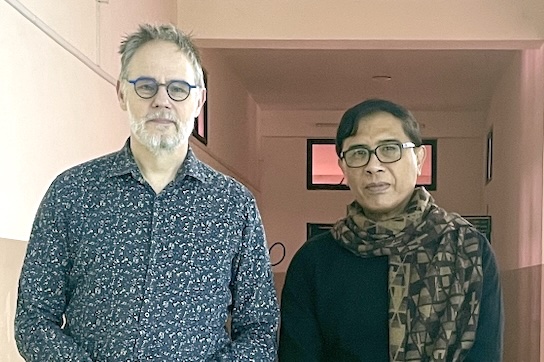
Last year, when visiting Assam in India’s Northeast, I was lucky enough to meet professor Gautam Borah, mere months before he was to retire as head of the University of Tezpur’s linguistics department. Even before he proved to be extremely helpful in furthering the research I was doing, I took an immediate liking to him, and I soon discovered that this feeling is widespread among those who know him.
Since his retirement, he has been writing – what he calls – ‘evening thoughts’ on a wide array of subjects, from philosophy and linguistics to music and science. (He distributes these through WhatsApp, an application I no longer use, but he is one of the reasons I can’t get myself to delete it from my phone.) What you’ve just read is the latest of these musings, reproduced here with Gautam’s kind permission.


Interessant. Ik probeerde het volgende aan het commentaar van Stephen J Henstridge toe te voegen maar kreeg daarvoor geen toestemming… Jaap
Mijn oude “Literaire Kunst” (HJMF Lodewick, 1955, p.73) geeft:
“De meest voorkomende gevallen van synecdoche zijn die, waarbij de naam van een onderdeel aan een geheel gegeven wordt (pars pro toto). Zo noemt Maria Tesselschade een vogeltje: ‘een zingendt veedertje’ en gebruikt Vondel ‘kiel’ voor schip’: Men klaeght, indien de kiele strand, enz.”
Dr J.A. Jasperse Whangārei, Aotearoa Nieuw Zeeland.
LikeLike
In both english and dutch there’s a word (from latin) for the situation where a part is used to refer to a whole: synecdoche.
So, I expect there must be some examples in dutch, too.
LikeLike